

Often times analysts and engineers are confronted with complex and volatile design spaces which are challenging to optimize. Highly nonlinear behavior common to such domains as fluid dynamics and structures under large deformations can result in multiple local optima. Unfortunately, when a design is close to a local optimum the engineer may never realize the potential gains of even bolder design exploration.
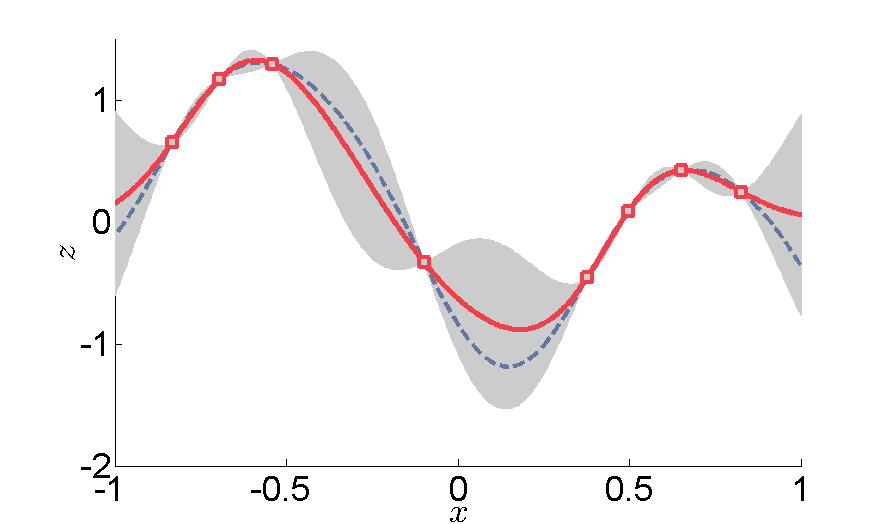
Most scientists and engineers are well aware of regression modeling, but struggle to correlate input and output when their data is not polynomial or exponential in character. For deterministic data, Kriging interpolation easily addresses this problem. Long used by geostatisticians to create topo maps from discrete elevation measurements, Kriging interpolation provides a framework for an unbiased prediction of functions between arbitrarily spaced samples in multi-dimensional space, making it ideal for modeling design spaces known to have highly variable local behavior.
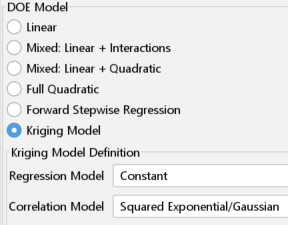
Using ILIAD’s Design of Experiments component, engineers may apply the Kriging model to data accumulated from previous experiments or acquired from coupling their CAE workflow with ILIAD’s numerous sampling algorithms. Despite the nonlinearities, the visualization tool allows users to easily see the approximate value and sensitivity of each optimum. Those pursuing peak optimization may then choose to refine their search space or launch an optimization sub flow from the suspected global optimum for even greater design improvement!
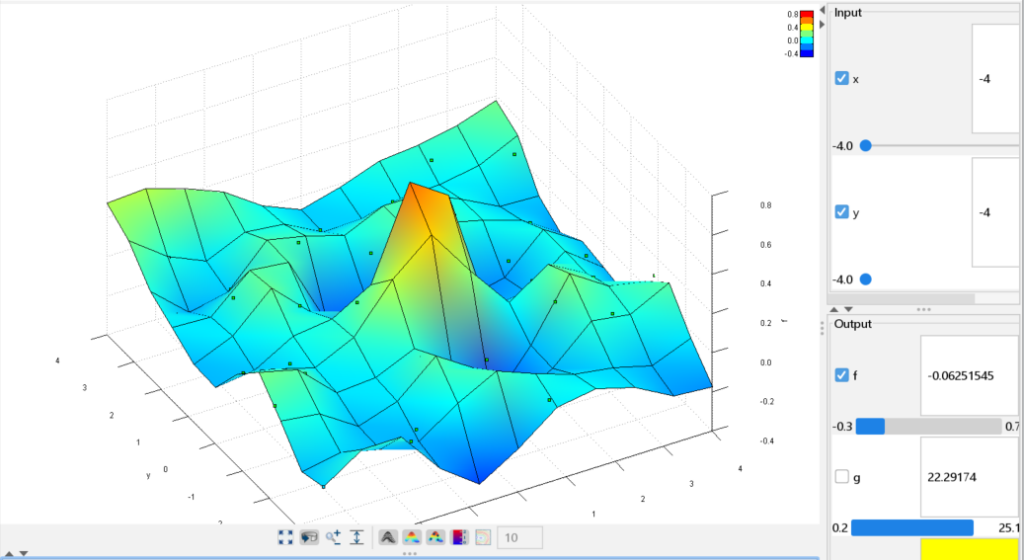
Image credit:
By Antro5 at English Wikipedia, CC BY-SA 3.0, https://commons.wikimedia.org/w/index.php?curid=52740780