

Introduction
Structural optimization is used to efficiently improve structures. Its usage requires the selection of two sets of quantities: Design variables and responses.
In a previous blog we described what responses are and what types of responses GENESIS provides to its users to help them define the objectives and constraints in their problem.
In this blog we will describe what design variables are, how they are created and how they can be used to define an optimization problem.
Form Follows Function
“Form follows function” is a well-established principle in architecture and industrial design. Design variables allow the optimizer to find the optimal form of the structure that satisfies the function it is created for. The function is defined by the user when selecting the objective and constraints.
Design Variables Available in GENESIS
Design variables are parameters that can change, directly or indirectly, the dimension of elements, grid locations, and/or material properties used in a finite element model that represent the structure which will be used to simulate operational loads and environment.
Design variables are related to structural optimization types. We will describe structural optimization types next:
Structural Optimization Types
The structural optimization types can be categorized into topology, sizing, topometry, shape, topography, and freeform optimization. Next, a brief description of each type is presented.
Topology Optimization
Topology optimization is a structural optimization type used to find the optimal material distribution within a designable space. The topology design space can contain almost any element in the FEA model. This includes solids, shell, composites and bars elements. The design variables in topology are the density of each element or the density at points on the space within the structure. The optimization process produces cavities where material is not efficient to keep and produces lighter structures than the original full design.

Figure 1, on the left, shows the design space, in the middle, it shows the topology results, and on the right is a CAD model representing the final results.
Sizing Optimization
Sizing optimization is a structural optimization type used to design specific dimensions or properties of structural members. The design variables here could be the thickness of the parts.
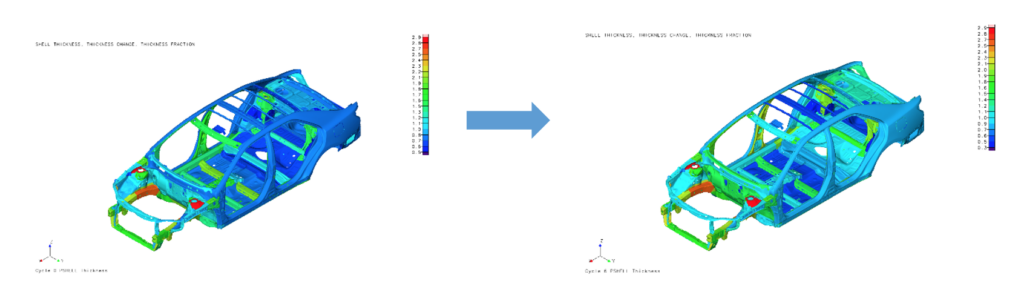
Figure 2, on the left, shows the thickness of the designable parts of the initial design, and on the right, it shows the final thickness of the final design.
Topometry Optimization
Topometry optimization is a structural optimization type used to design structural dimensions or properties of individual elements. This method can be used to find optimal thickness distributions on shell elements and on any other elements that has physical dimensions such as bars, rods, composites, etc.

Figure 3, on the left, shows the initial design space and on the right, it shows the final design. Topometry optimization designed here every element thickness of the structure. Note that the horizontal “arms” on the final results are tapered while the arms in the initial design were uniform. The final topometry design is 10% lighter than the initial design which itself was previously optimized using sizing optimization.
Shape Optimization
Shape optimization is a structural optimization type used to design the shape of structural boundaries (i.e. designing the locations of the grids). Shape optimization can be used to design shapes of solids, shell, bar, rods, etc.
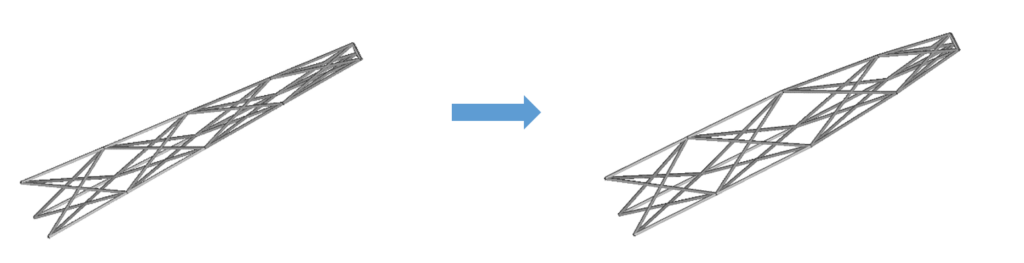
Figure 4, on the left, shows the initial design of a truss structure and on the right, it shows the final and optimal design. Shape optimization designed the location of certain grids of the structure. The figure shows that the final result is wider than the original design.
Topography Optimization
Topography optimization is a structural optimization type used to design surface grids on shells or composite elements. It can also be used to design surface grids of solid structures. This method uses automatically generated perturbation vectors and is it typically used to find optimal bead patterns.
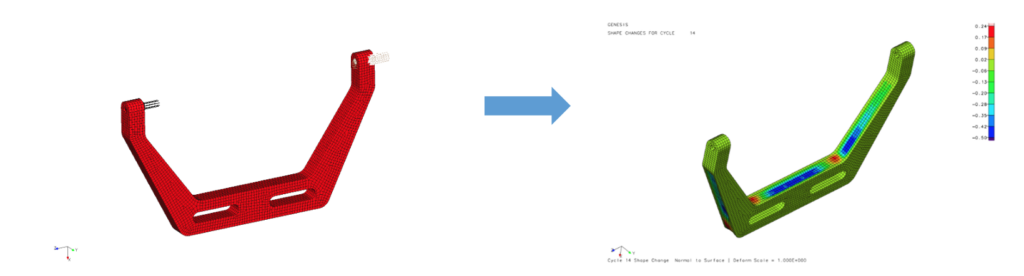
Figure 5, on the left, shows the initial design of a solid structure and on the right, it shows the final design. Topography optimization designed the location of surface grids carving out material producing the lightest design. In this problem fatigue life was used as a constraint. The colors represent the material carved.
Freeform optimization
Freeform optimization is another special case of shape optimization. In this type of optimization, the program splits user-given perturbations into multiple perturbations on a grid-by-grid basis. This increases the variability of the design space when compared with traditional shape optimization. Freeform, unlike topography optimization, can be applied to any type of element. Freeform can be used to design ribs on solid components and to design bead patterns of constant and/or variable height.

Figure 6, on the left, shows an example using a solid plate. The solid plate is subject to multiple torsional loading conditions. The structure is designed to be as stiff as possible for the applied loadcases. The design problem is to find the shape of ribs that minimizes the strain energy by moving up to 45% of the designable grids and ensuring three mirror symmetries along the center. Figure 6, on the right, shows the final freeform optimized shape. In that figure, red corresponds to the highest possible movement of the grids and blue corresponds to the lowest movement. Notice that ribs have emerged out of the flat initial design.
Discussion and Summary
The GENESIS user can use up to six types of optimizations: Topology, sizing, topometry, shape, topography and freeform. These types of optimizations can be mixed and matched as needed. The user, for example, can perform sizing, shape, and topology optimization on a single problem. These types of optimizations are used to define the design space and they implicitly or explicitly define the design variables of the problem.