Optimization is typically applied to deterministic problems, i.e., a problem in which all variables have an exact value and that can be calculated using fixed mathematical formulas. However, in real life, it is almost impossible to measure the exact values due to several reasons including instrumentation error, manufacturing limitations etc. To counter this, tolerances are used which help to account for the randomness. How does one account for these tolerances when such random variables are used as inputs to an optimization study?
OmniQuest’s answer to this is the
Probabilistic Analysis component inside Iliad. This component can estimate the uncertainty in the output variables resulting from the error propagation of the input variables. Depending on the configuration, the Probabilistic Analysis component can be used in three ways:
- Reliability Analysis – Evaluating the probability of failure (POF) for a single design point.
- Reliability Optimization – Minimizing the probability of failure (POF) of the objective function to get the design point that has maximum reliability.
- Robust Optimization – Minimizing the standard deviation of the outputs or reducing the variation in the outputs.
For each of these cases, the starting point is configuring the workflow containing a probabilistic analysis component. The user then selects the method used for estimating the uncertainty in the responses by switching to the component editor tab.
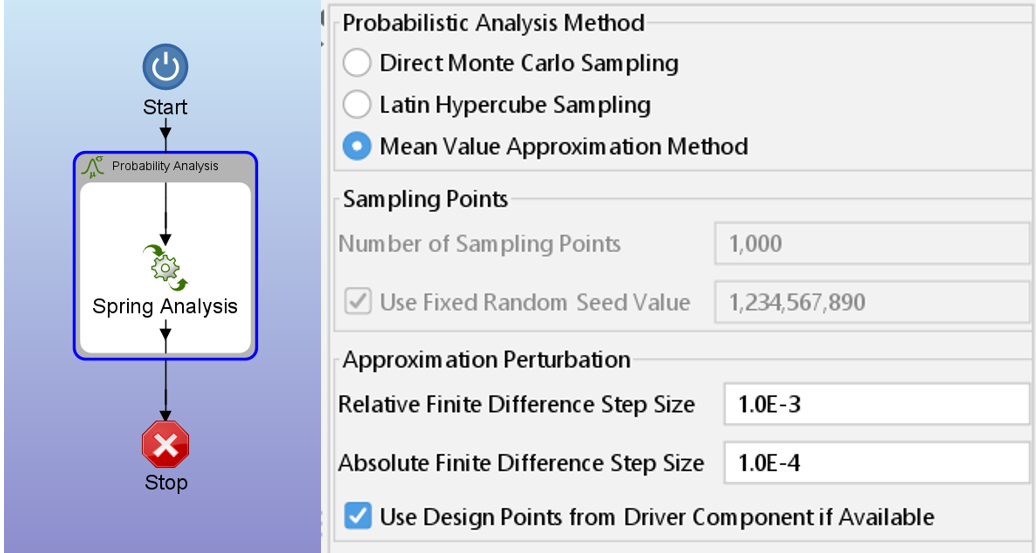
Next, the user inputs the type of distribution for the input values – parameters such as mean and standard deviation. Currently four different distributions including Normal, Uniform, Log Normal and Weibull are supported. If some inputs are deterministic, they can be configured as such by unchecking the ‘Random’ column box. Thus, a mix of both deterministic and probabilistic variables can be run in the same study.
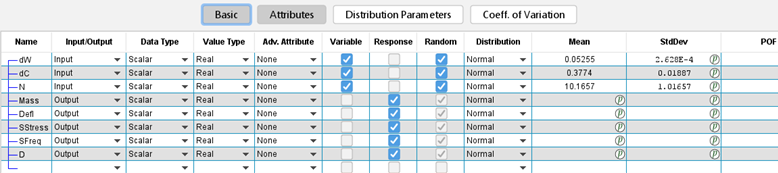
Once the inputs are configured, the problem is run in the same way as a typical deterministic optimization study. In subsequent articles, we will see specific examples on each of the three cases.
Connect with us now for complimentary webinars and evaluation software.
Our engineering team can work with you to conduct a Test Case showing how OmniQuestTM will improve your designs, processes and your overall business

